Life
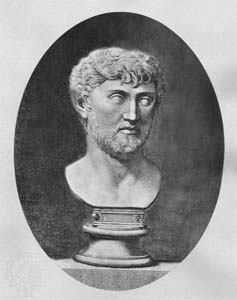
Very little is known about Titus Lucretius Carus except as that he was an author of a single work, the De Rerum Natura, a poem on Epicurean beliefs. Nothing is mentioned of his birth, life, or death. Attestations about his life are late. From Jerome and Donatus, Lucretius appears to have been born around 100 BCE and died around 55 BCE, although the death date is thought to originate from a letter of Cicero, dated 54, in which he has read the De Rerum Natura. It is quite possible that Lucretius lived afterward, perhaps even to the dictatorship of Julius Caesar if a) the reference to Venus as the begetter of Romans in the proem to his De Rerum Natura is a reference to Caesar, and b) the proem was revised after publication (not at all an impossibility).
The De Rerum Natura is dedicated to Gaius Memmius, the same who took Catullus with him to Bithynia and to whom Cicero wrote asking not to tear down the ruins of Epicurus’ house on land he owned in Athens. This action would have likely sparked outrage to Epicureans, who revered him as a saintly prophet, and therefore it is possible that the dedication to Memmius was connected in some way to his ownership of that property.
Works
The De Rerum Natura is a didactic poem written in hexameters and divided into six books. It is frequently considered to be the greatest exposition of Epicurean philosophy in Latin. Lucretius begins with an account of the atomic theory of Democritus and the nature of the cosmos.
Lucretius then moves into the nature of man and the mind. In the third book, the middle of the poem, he discusses death and the mortality of the soul, in what is seen as an homage to the underworld scene found in the middle of other epics (chiefly Odyssey 11 and Aeneid 6). He then discusses the “images” of things—that which is projected from an object either as a dream or as an actual vision.
The fifth book is an explanation of how the world came into being: the earth and the heavens, and the origin of man and civilization, all of which, Lucretius explains, are part of a process of natural laws, not of any divine figure. The sixth and final book discusses natural phenomena and affirms the materialistic nature of the workings of the world, as opposed to the divine.
The very end, a description of plague, ends so abruptly that many think it is incomplete, though David Bright argues that the ending is intentional and modeled after Thucydides’ History of the Peloponnesian War, which also ended abruptly after he succumbed to the Athenian plague. That Lucretius committed suicide (first reported by Jerome) is probably a conjecture devised to account for the seemingly incomplete state of the poem, but most modern scholars reject this idea outright.
The purpose of the De Rerum Natura is to present Epicurean beliefs in a way which would please educated Romans. Although the work is dedicated to Gaius Memmius, it was intended for any Roman who did not already adhere to Epicureanism. In order to accomplish this, Lucretius had to soften the message a bit, sprinkling in myths in order to appeal to upper class sensibilities:
“But as physicians, when they seek to give
Young boys the nauseous wormwood, first do touch
The brim around the cup with the sweet juice
And yellow of the honey, in order that
The thoughtless age of boyhood be cajoled
As far as the lips, and meanwhile swallow down
The wormwood’s bitter draught, and, though befooled,
Be yet not merely duped, but rather thus
Grow strong again with recreated health.” (1.936-951)
Legacy
Lucretius’ reception in antiquity appears sharply divided. No contemporary Epicureans seem to have mentioned him in their writings, and he is entirely absent from the Herculaneum fragments. However, he was well-received as a poet. Ovid, Vitruvius, Quintilian, and Statius all admire his poetical skill, and Nepos proclaimed him one of the greatest poets of all time. Despite showing disdain for Epicureanism in general, even Cicero speaks highly of his poem.
Lucretius Online
Latin: PHI Latin Texts
English: Internet Classics Archive
English: Perseus
Further Reading
- David F. Bright. “The Plague and the Structure of De rerum natura.” Latomus 30.3 1971: 607-632.
- John Douglas. Lucretius and the Late Republic: An Essay in Roman Intellectual History. Leiden: Brill, 1985.
- Monica Gale. Myth and poetry in Lucretius. Cambridge: Cambridge University Press, 1994.
- E. J. Kenney. Lucretius. Greece & Rome 11. Oxford: Clarendon Press, 1997.
- David Sedley, Lucretius and the Transformation of Greek Wisdom. Cambridge: Cambridge University Press, 1998.
- Daryn Lehoux, A. D. Morrison, & Alison Sharrock eds. Lucretius: Poetry, Philosophy, Science. Oxford: Oxford University Press, 2013.
